The international passenger terminal has been designed to be as considerate to the surrounding environment as possible. We call it the “Eco Airport”. A large range of measures are in place to minimize environmental impact in terms of atmospheric pollution, noise, vibrations, water, soil, waste matter and energy, and we are working aggressively to minimize carbon dioxide emissions.

|
|
|
The foundations of the terminal's various buildings are kept stable with piles driven deep into the earth. These piles collect the heat that resides in the ground, and heat pumps use a natural refrigerant to harness that warmth from the piles and use it to heat and cool the terminal. Using this environmentally considerate system, no heat is released into the atmosphere.

The new Haneda Airport International passenger Terminal incorporates cogeneration technology and is equipped to make efficient use of purchased energy Electricity made with gas-powered engines is used to light the terminal building, while the heat generated in that process is harnessed for efficient use in the terminal's heating and cooling systems, and hot-water supply.
We install the NAS Battery (Mass Storage Battery) for the first time at the Airport around the world. It can discharge the electricity, according to the demand in the daytime, which was charged at the night when the electricity price is very cheap because of the low demand.
We have endeavored to make the new Haneda Airport International passenger Terminal as user-friendly as possible, incorporating the principles of universal design so that every customer can make use of our facilities easily and with peace of mind. As part of our effort to promote universal design, we established a Universal Design Committee, drawing on a wide range of people to bring a broad perspective to its decisions. These included experts in the field, people with disabilities (e.g., wheelchair users, those with limited use of limbs, blind and sight-impaired people, and those with hearing disabilities) as well as representatives from relevant businesses such as airlines and railways. These experts and people with disabilities also participated in workshops under the umbrella of the committee. This allowed us to conduct trials using actual facilities instead of simulations and models, and we were able to elicit participants’ opinions, discuss improvement measures and incorporate these into installations and operation plans.
Previously, the passenger boarding bridges that connect aircraft with airport terminals have tended to be comprised of different levels. The Haneda Airport International passenger Terminal, is the first to introduce step-less passenger boarding bridges, which have no split levels. Wider and flatter walkways mean less stress for wheelchair users and other people with limited mobility when using the passenger boarding bridges to board and alight from aircraft.

The regular toilet facilities at terminal building are spacious enough for wheelchair users and people with bulky suitcases to use. Furthermore, each block of toilet facilities has one or two multipurpose toilets to serve the needs of wheelchair users, the elderly, Ostomate users, and people with infants. Generous space is afforded in order that these highly functional facilities may be used in comfort.

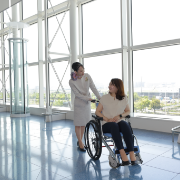
Terminal building offers assistance to customers with disabilities and elderly customers. Those who require assistance can ask upon arrival or book in advance(Reservations accepted by telephone or fax, or online.). We also have standardized wheelchairs in all areas of the terminal. These are designed to fit into aircraft aisles so passengers can go right to their seats on the aircraft.

Terminal building offers transportation along departure and arrival concourses by mobility cart for elderly customers and those with physical disabilities or with small children, thus ensuring smooth, stress-free movement for those in need.

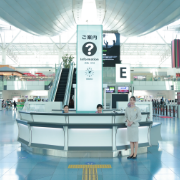
To ensure clear communication with passengers with hearing or speech impairments, information counters are equipped with message boards for written communication, as well as original terminal building Communication Support Boards.

In addition to regular emergency buttons, elevators in the terminal are equipped with emergency assistance button for hearing impaired passengers on elevator. In emergency situations, these buttons let people outside the elevator know that there are hearing-impaired passengers inside.

Terminal building’s flight boards use UD fonts and larger-sized text than airports have traditionally used. We have also achieved greater contrast between text and background in order that flight information is more clearly visible to all.

Terminal building is the first airport in Japan to offer dedicated indoor toilet facilities for guide dogs (i.e., dogs to assist people with seeing, hearing and other impairments). Facilities are located on the first floor.